
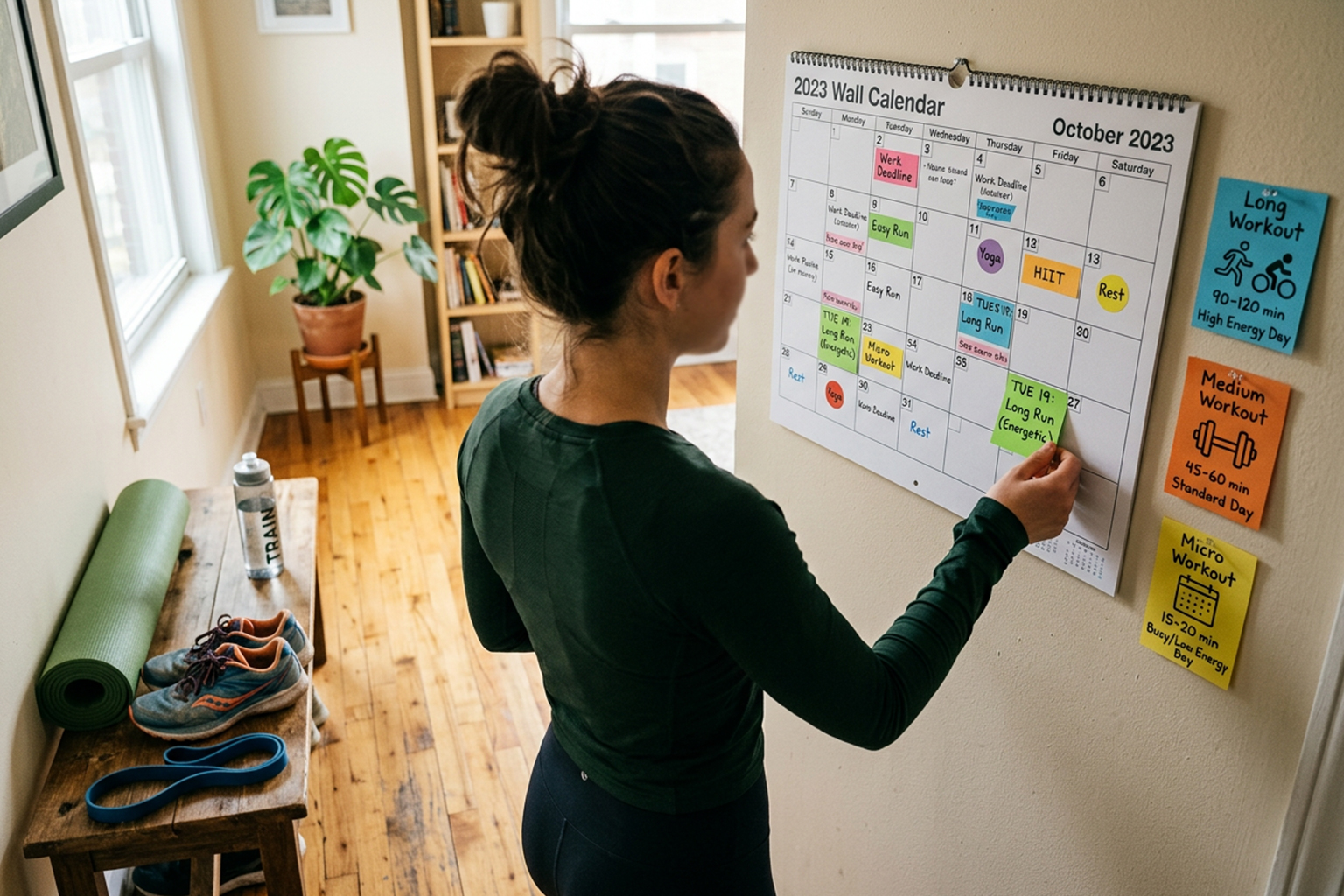
Understanding how your workload and daily energy affect fitness choices helps you maintain progress without burnout. Instead of rigid plans, aim for a structure that bends with work demands and personal rhythms to preserve consistency. This article outlines practical steps to map energy, choose adaptable sessions, and protect recovery so training stays realistic. Use simple rules rather than strict schedules to keep movement sustainable across changing days.
Assess Your Weekly Energy Patterns
Begin by tracking energy, obligations, and sleep across a typical week to identify realistic training windows. Note peak focus times, heavy task days, commute or meeting clusters, and how sleep influences daytime capacity. Use a simple scale—low, medium, high—to rate morning and evening energy for several days, and record where momentum drops. You can track this in a notebook, a calendar, or a basic habit app to make patterns visible.
- Record three data points per day: energy, priority tasks, and sleep quality.
- Review weekly to spot repeatable windows for longer sessions.
- Flag days better suited to micro-workouts or recovery.
Mapping removes guesswork and highlights realistic training windows you can actually keep. With this evidence, scheduling becomes about matching effort to available energy rather than forcing a fixed routine.
Design Flexible Session Templates
Create three to four templates that vary by length, intensity, and focus so you can match a session to your energy level. For example, have a 45–60 minute strength template for high-energy days, a 20–30 minute mobility plus conditioning mix for medium days, and 8–12 minute micro-workouts for low-energy or time-crunched moments. Keep movements versatile so each template supports strength, mobility, or conditioning depending on the goal, and include progression cues to guide overload over time. Assign templates to days based on your energy map rather than fixed clock times so adherence stays high.
- Long session: compound lifts, structured warm-up, 40–60 minutes.
- Medium session: circuit of mobility and short conditioning, 20–30 minutes.
- Micro-workout: 8–12 minutes of high-value moves like squats, push patterns, and core work.
Templates reduce decision fatigue and let you adapt without losing training quality. Over weeks, they encourage steady progression by prioritizing consistency over perfect conditions.
Prioritize Recovery and Small Wins
When workloads change frequently, recovery planning is essential to sustain performance and lower injury risk. Schedule brief restorative actions—short walks, targeted stretching, consistent sleep windows, and hydration checks—to protect capacity between busy days. Celebrate small wins like completed micro-workouts, maintained sleep routines, or regular mobility practice; these reinforce habit loops and steady motivation. Reassess your energy map monthly and adjust recovery or session choices as demands shift.
Small, consistent actions compound into meaningful progress without adding complexity. Keep tweaks modest so changes are sustainable and less likely to be abandoned.
Conclusion
Align training to how you live by matching sessions to real energy patterns and workload demands. Prioritize flexible templates, energy-informed scheduling, and recovery actions to make fitness resilient and sustainable. That approach supports steady progress without requiring perfect days or rigid plans.
